
• Lebenslauf • Schriftenverzeichnis •Blog • Impressum • Home
|
|
• Lebenslauf • Schriftenverzeichnis •Blog • Impressum • Home |
||
| Deutsch | English | Español |
2nd edition 2010 (December)
3nd edition 2012 (May)
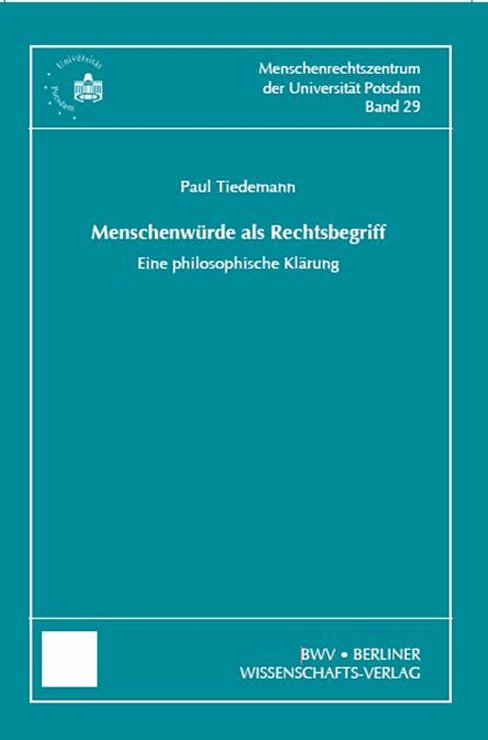
This work is the culmination of 14 years of research and enquiry into the philosophy and law of human dignity. The book seeks to contribute to a responsible application of the expression "human dignity". The enquiry shows that the concept is originally a philosophical one. It has a very distinct philosophical meaning. This is contrary to its, mostly, inaccurate usage in the political, ethical and legal realm. It is demonstrated why "human dignity" must rightly be regarded as the absolute highest value. Although the application field of this value may be small, its weight is unquestionably strong.
Since the idea of "human dignity" is a philosophical construct, it cannot be understood clearly without a philosophical analysis of its content. Consequently, fifteen chapters address the topic from a philosophical perspective, while two chapters are devoted to the legal history and a further chapter examines the theory of law in light of human dignity.
Each chapter includes a summary, both in German and English. An extensive bibliography and list of relevant national and international jurisprudence informs and completes the study.
The chapter summaries are outlined below:
The term Human Dignity has been part of the concepts inventory of interna-tional law since the founding of the United Nations Organisation. UN law envisages human dignity as an universal pre-legal value appreciated by all peoples of the world. However, until now it was deliberately avoided to pro-vide a philosophical substance for the term. Since the international cove-nants of 1966 many documents contain the formulation that human rights are derived from human dignity.
Under the influence of UN-law the term of human dignity also has found its way into the law of regional international agreements and numerous na-tional constitutions. Even though, however, the fundamental idea of UN law frequently was not adequately absorbed.
In spite of a more than 60-year long continual legal discourse about human dig-nity, which particularly in Germany was very intense, there is no general consen-sus regarding the meaning of the concept to this day. Primarily the dissent be-tween an heteronomical and an autonomical understanding of human dignity is of special importance. The dissent is based on the refusal of jurists to approach the concept with philosophical and rational methods.
The heteronomous concept of human dignity is based on choosing a good life in moral terms. Those choosing differently fail to grasp the meaning of life, and con-sequently to achieve their dignity. This idea of human dignity goes back to the Greek/Roman Stoa and was taken over by Christianity as well as by modern ra-tionalist natural law concepts. It is, however, also found in Confucianism.
In accordance with the autonomous concept the dignity of human being is based on his/her freedom of will. In contrast to animals human beings are not determined by drives, but are free to design their lives. At any given moment they are able "to repent their sins" and to change their lives. This concept is a discovery of Euro-pean renaissance, and no parallels can be found in other cultures.
Developing a theory of human dignity must be based on a universally valid ap-proach. Universal validity means that irrespective of an individual's cultural back-ground every human being, in principle, must be able to comprehend this method. The method of argumentation applies universally. Logical, transcenden-tal, linguistic, analytical, phenomenological, empirical, and evaluative arguments are permitted.
Human dignity designates the value judgement: "Human beings have absolute value." Values are subjective standards according to which we decide which ob-jects are given preference over others. An absolute value is absolutely binding, i.e. it is not possible to carry out a valuation without consideration of such a standard. The meaning of the word dignity (absolute value) does not allow for any derivation regarding the criterion of such a standard.
The free will is an absolute value for every person because freedom of will is the condition of authenticity and identity. The condition of the possibility to learn au-thenticity is the recognition of the individual as a person by others. An individual can accept this attitude of recognition only if it realizes that others are persons like itself. The absolute esteem of one's own being is therefore equiprimordial with the absolute esteem of somebody else's being. Therefore, human dignity is a collective absolute value.
This chapter will initially examine whether the argumentation developed in chapters 6 and 7 is compatible with the methodical considerations made in chapter 5. Thereupon, possible objections to the argumentation are debated, showing the invalidity of all these very objections.
Human life in dignity is not possible in situations in which an individual's freedom of will is restricted or destroyed or if there is the specific danger of such a restriction or destruction. The lack of these situations (liberties) can be described as respect spheres of human dignity. The physical-mental integrity is part of these respect spheres. It is threatened by torture and other damage to the body and mind which have similar consequences.
The pure existence (the life) of persons is a respect sphere of human dignity al-though it is possible to kill a person without violating its human dignity. Those who think they own the right to dispose of personal life at their discreation undermine the appreciation of their own dignity and the dignity of all other individuals.
In numerous contemporary legal and ethical discourses the argument of human dignity plays a substantial role, although there is no justification for it. This is dem-onstrated on the grounds of some examples, namely the justification of the protec-tion of public self-projection, the justification of the discrimination ban, the criticism of "humiliation", the justification of property right and a "right to employment", the justification and criticism of the ends and principles of punishment, the criticism of genetic engineering, as well as the justification of "collective human rights" and of a postmortal personal right.
Where human dignity conflicts with other values (e.g. freedom, equality, state sov-ereignty), human dignity should always be given priority. Value-conflicts between human dignity and human dignity can, in some cases, be resolved through the criteria of moral inability, free choice or the distinction between anthropogenic and fateful inhumane conditions. There is however such a thing as 'dignity against dig-nity' - conflicts that cannot be resolved (dilemmas). Two rules to assist in such cases are discussed. In accordance with the absolute priority of human dignity, aid for those in need is reasonable to the point of the own humane subsistence level of every helper.
Human dignity as an absolute subjective preference is a second-order volition. It can come into conflict with our first-order volitions. In such a conflict we ex-perience our respect for human dignity as a duty. In order to safeguard the ob-servance of these human duties, persons grant each other human rights.
Human dignity is a condition of possibility of every system of laws. This does nei-ther necessarily imply a legal duty of the state to protect human dignity nor the legal duty of all people to respect the human dignity. Human dignity is the founding principle of all fundamental rights, in so far as they pertain to human rights. The principle of human dignity has consequences for the recognition of right subjectiv-ity. The international Human Rights Conventions provide additional control mecha-nisms for the preservation of the human dignity.
Most constitutions declare besides human dignity still other basic values. The rela-tionship between human dignity and such basic values is clarified by the example of the basic value catalog of the European Union that enclosures, besides human dignity and human rights, also liberty, equality, democracy, and the rule of law. Liberty means freedom of action and demands the justification of restrictions. Equality means equal treatment in the allocation of contributions and profits of a cooperation. It demands the justification of any unequal treatment. Human dignity stands above these values. Democracy is a mechanism for connecting political power with the public opinion. Human dignity is one of the conditions for its exis-tence. The rule of law is a state instrument for upholding human dignity, liberty and equality.
Non-personal living beings are not allocated dignity because people cannot identify themselves as authentic persons through non-personal living beings. Non-personal living beings thus have no absolute value for persons. The expression "the dignity of the creature" therefore leads to unnecessary confusion and should be avoided.